

Jewelry 3D Rendering Services: From CAD file to store-ready product images
Jewelry 3D rendering turns a CAD model into photorealistic product images without a physical sample or a photoshoot.
This page explains how 3DJewels Studio runs that process: what we need from you, how a manufacturing model is prepared for close-up visualization, how materials and lighting are built, how metal and stone variants are produced from one scene, and how the finished images are delivered for your online store, catalog or presentation.
Who this service is for
Jewelry brands and online retailers. You sell made-to-order or customizable pieces and need a complete, consistent set of images for every metal, stone and size option, ideally before production begins.
Workshops and manufacturers. You already work in CAD and need clear presentation visuals for clients, sales teams or wholesale catalogs, without building a separate photography workflow.
Independent designers. You are preparing a portfolio, a pre-order page or a crowdfunding campaign and need images that match the quality of your design.
Studios and CAD teams. You model well but prefer to hand off visualization, or you need extra capacity during busy periods.
Why render instead of photograph
A single ring style can be offered in several metals and a dozen stone shapes. Producing each combination as a physical sample, then styling and photographing it, is slow and expensive, and the cost grows with every new collection.
With 3D rendering, the CAD model you already have becomes the source of every image. A change of metal or stone is a change inside the same scene, not a new sample. This gives you three practical advantages:
- Lower cost per image once the first scene is approved
- Pre-production marketing, because pieces can be shown and sold before they are cast
- Visual consistency, because every image comes from one pipeline with identical lighting, angles and framing
Our process
1. Brief and file intake
We need three things to begin.
The CAD file. We accept Rhinoceros (3DM) files as the preferred format, and also STEP, OBJ, FBX and STL. The model should be in millimeters at real-world scale so that stone sizes and band dimensions are interpreted correctly.
A list of outputs. Metals (yellow, white and rose gold, platinum, silver), views, stone shapes and colored gemstones, plus the final image size and background type.
References for unusual details. A facet diagram, a sketch or a color sample is enough for rare cuts and special stone colors.
If you want the images to go directly into your store, send your file naming convention with the brief. It is far easier to name files correctly during production than to rename them afterward.
2. CAD audit and render preparation
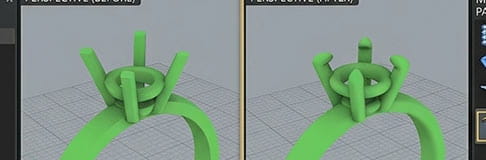
A model prepared for casting is not automatically ready for visualization. A macro render exposes details that a manufacturing process tolerates, such as open edges, overlapping surfaces, simplified galleries or stones that touch metal at a single point.
Before materials are applied, we review and refine the model:
- Prongs and settings are reshaped so their profile follows the design intent and catches light correctly
- The gallery under the center stone is modeled to realistic proportions, since it is visible through the pavilion
- Stone seats are checked for gaps and intersections
- Pavé and channel stones are placed and verified individually
- Mesh density is tuned for smooth reflections on curved polished surfaces
This stage defines final quality and takes the most time. A clean model makes every later step faster and more predictable. If the model needs to be built or reworked rather than refined, our jewelry CAD modeling service covers that step within the same project.
3. Materials: metals and gemstones
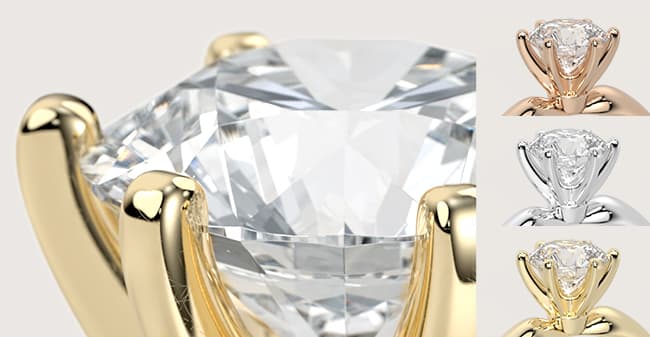
Believable jewelry depends on accurate materials. Each alloy has its own reflectance, tint and surface finish, and each gemstone has its own optical behavior.
Metals. Yellow gold, white gold, rose gold, platinum and silver are separate calibrated materials. Polished, satin and brushed finishes are variants of the same base, so a different surface does not require a new scene.
Diamonds. A diamond is not just a transparent object. Its look comes from a high refractive index (about 2.42), strong internal reflections and dispersion, which produces colored fire. We set these values deliberately and balance ray depth and caustics so the stone stays brilliant without noise or dark areas.
Colored stones. Ruby, sapphire, emerald, aquamarine and others use their own index values, absorption and inclusion levels, and the color is matched to your reference.
Contact details. Slightly rounded edges, controlled micro-texture on satin metal and correct color transfer from a colored stone to the surrounding metal all contribute to realism at close range.
4. Choosing the render engine
The right tool depends on the project, not on habit. We select the engine based on your deliverables, your existing pipeline and the type of image required.
- KeyShot is a strong choice for fast, consistent still images and large catalogs.
- V-Ray, Corona and Octane suit projects that need deeper control or integration with a 3ds Max or similar pipeline.
- Blender works well for stylized scenes, compositions and animation.
- Rhino-based workflows are useful when the model needs to stay linked to its original file.
The principles do not change between engines: clean geometry, physically based materials and a fixed lighting setup. Engines handle some effects, such as diamond dispersion, in different ways, so we adapt the method to each one. If you want a specific engine, tell us in the brief. If you do not, we choose for you.
5. Lighting and scene setup
A jewelry scene has to control reflections on mirror-like metal while keeping stones bright and readable. Our standard setup has three layers:
- An HDRI environment for natural reflections and soft base light
- Softbox-style area lights that define metal edges and give stones their highlights
- Reflection cards and flags that add or remove contrast in specific areas, in the same way a photographer uses white and black cards
When the scene is approved, it is locked. Cameras, lights and backdrop stay identical across all variants, which is what keeps a large catalog visually uniform.
6. Standard views
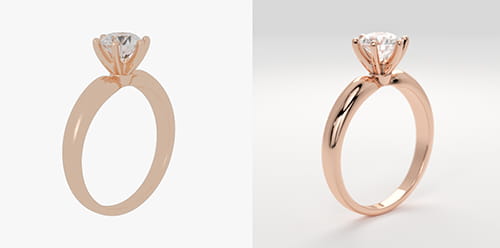
We agree on a set of views at the start and keep them identical across the project.
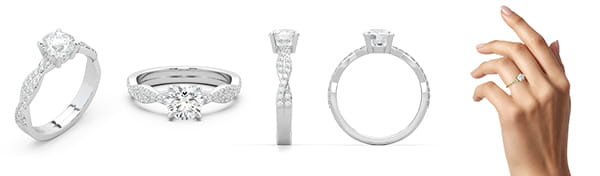
- Flat view: an overhead shot that shows the face of the stone and the proportions of the band. Often used as the main product image.
- Standing view: the piece upright and slightly angled, showing setting height and shank profile.
- On-hand view: the piece on a hand model, which gives the buyer a clear sense of scale.
Close-ups of settings, engravings or clasps can be added where a design has details worth showing. Pendants, earrings and bracelets use their own angle sets under the same principle of fixed cameras and repeatable results.
7. Variants from a single scene
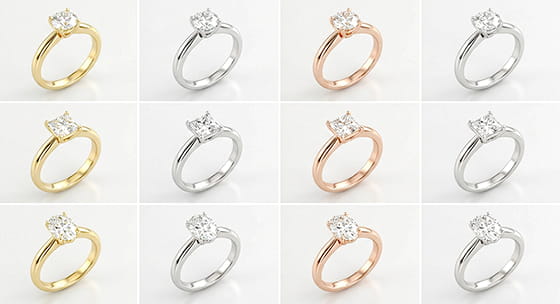
This is where rendering becomes economical. The first scene takes the most effort, because it includes preparation, materials, lighting and cameras. After that, most variants reuse everything except one element:
- Metal variants: only the metal material changes.
- Stone shape variants: the stone and its seat are swapped, and prongs are adjusted if the new shape requires it.
- Gemstone color variants: the gem material changes while geometry stays the same.
The cost of each additional image falls sharply after setup, and the results stay consistent because they come from one pipeline under one set of conditions.
8. Quality control and delivery
Every image is checked at full resolution before delivery. We look for gaps or intersections between stones and metal, noise or dark patches inside gemstones, color accuracy of metals, consistent framing and scale, and clean edges on transparent or white backgrounds. Where needed, light retouching is applied while keeping the image true to the model.
Typical deliverables include:
- High-resolution PNG or JPG files
- Versions with transparent or white backgrounds
- Web-optimized copies for faster page loads
- File names that follow your store’s variant structure
Named correctly, the images upload to Shopify, WooCommerce and other platforms that assign pictures by variant without manual sorting.
Timelines and pricing
Turnaround depends on the number of styles, model complexity and the number of variants. A single ring in two metals and three views is usually completed in 2-4 working days. For ongoing catalog work, we plan production around your release calendar so that each collection moves through the same pipeline without delays.
Every project is quoted individually based on your files and requirements. Send us the details through the quote form and you will receive a clear estimate.
Related resources from 3DJewels
If you prefer to build the skill in-house, 3DJewels also provides the tools we use as part of our own workflow:
- Ready-to-use 3D jewelry models
- Scene setups and HDRI maps for jewelry visualization
- Textures and material libraries
- Render settings for 3ds Max, V-Ray, Blender, Octane Render, Corona Renderer, Rhinoceros and KeyShot
- A course on jewelry rendering in KeyShot
Frequently asked questions
Rhino (3DM) is preferred. We also accept STEP, OBJ, FBX and STL. Models should be in millimeters at real-world scale.
Yes. This is the main use case. The render is built from the CAD model, so the physical piece does not need to exist.
Yes. We can model alternative stone shapes and colored gemstones from a facet reference or a color sample.
We choose the engine that fits your deliverables and pipeline. KeyShot, V-Ray, Blender, Octane and Corona are all part of our workflow, and you can request a specific one.
Yes. Send your naming convention with the brief and the files will be delivered ready for upload.
Yes. 3DJewels Studio offers jewelry CAD modeling as a separate service or as part of a combined modeling and rendering project.
Yes. Send one CAD file with a short list of metals and views, and you will see the workflow on your own design before committing to a larger volume.
Start with one piece
Send us one CAD file and a short list of metals and views. We will review it, confirm the scope and reply with a quote. Request your quote at 3djewels.pro.